前言:這篇部落格的雛形是一篇我在大學的英文作文課寫的文章,前陣子突然翻到覺得有趣(自己說),就決定翻成中文再修改一下放上來(自己的 essay 自己翻譯!)內文的詮釋和分析現在的想法可能又有些不一樣,不過這邊並未再多加修改,想說可以記錄一下十九歲的想法(笑)
Note: This is an essay I wrote in university for the course English Composition II. Princess Mononoke is one of my favorite films, and I think it would be an interesting idea to share this essay in my blog. I’ve translated it into Mandarin and included the original English text below. Some of my opinions and analysis (and of course writing skill lol) may have changed now. But I didn’t edit the text since I’d like to keep my 19-year-old self in this blog 🙂
《魔法公主》是吉卜力工作室1997年的電影,由宮崎駿擔任編劇和導演。
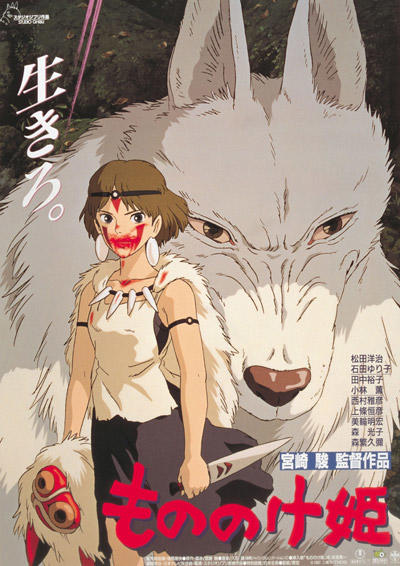
故事發生在室町時代(大約西元十四到十六世紀),蝦夷族少年阿席達卡為了阻止「邪魔」攻擊村莊而殺了祂,並因此受到詛咒。在村裡女巫的建議之下,他出發前往西方,去尋找解除詛咒的方法。
途中他遇到了疙瘩和尚,得知「山獸神」或許可以解除他的詛咒。而他在河邊救起的兩個重傷男人則告訴他,自己是達達拉城的人,這座城的首領是黑帽大人,城裡製造石火槍和鐵彈並和山林動物對戰,以獲取更多自然資源。
阿席達卡在達達拉城目睹了山林神靈、朝廷勢力、黑帽大人(達達拉城)之間的衝突,並在試圖阻止黑帽和魔法公主打鬥時被石火槍擊中而受傷。
魔法公主名叫小桑,是由山犬神族所養大的人類少女,和山犬一同對抗入侵山林的人類。她將受傷的阿席達卡帶回森林,阿席達卡的槍傷在山獸神的治療下痊癒了,詛咒卻沒有解除。與此同時,野豬神族正準備拚上一切攻擊達達拉城⋯⋯
故事最終,黑帽和朝廷的人一同擊落了山獸神的頭,而山獸神在尋找自己的頭顱時引發了對地表生命的毀滅,直到阿席達卡和小桑將頭還給祂後,一切才歸於平靜。山獸神死了,但祂也帶來了新的生命,並解除了阿席達卡的詛咒。
許多對這部電影的討論都聚焦在人類和自然的衝突上。但這次我想討論的是我觀察到的另一個有趣面向——性別角色。
性別刻板印象在全世界大概都非常普遍,而我個人覺得這在日本動漫中又特別明顯。標準的動漫男性角色通常很強、很酷、帥、會保護人,且心地善良。男性角色也常被賦予能夠以帶有情慾的眼光「欣賞」女性角色的權利(最經典的大概是《哆啦A夢》裡大雄偷看靜香洗澡)。另一方面,女性角色的特質通常是可愛、有禮貌、不冒犯人,且外型多半符合主流性感審美。女性角色也常常需要男性角色的保護。
這樣的性別設定或許跟日本的社會現況有關係,跟西方社會(和台灣?)相比,性別角色在日本似乎有著更明確的界線分別。
但是,這樣的現象在《魔法公主》這部1997年上映且背景設定在十六世紀的作品中,卻並不明顯。
《魔法公主》的主角阿席達卡同樣也有這些典型的動漫男性角色特質。他非常強壯,能和人打鬥,會射箭,可以保護村莊。他長得也很好看,極具魅力,這點從達達拉城的女性們看到他的反應便能明顯看出。阿席達卡想要「以清澈的眼光看待事物」,他的觀察力敏銳,會留意周遭的事物,並試著在評斷事物以前先了解各個面向的觀點,這也是阿席達卡的善良之處。
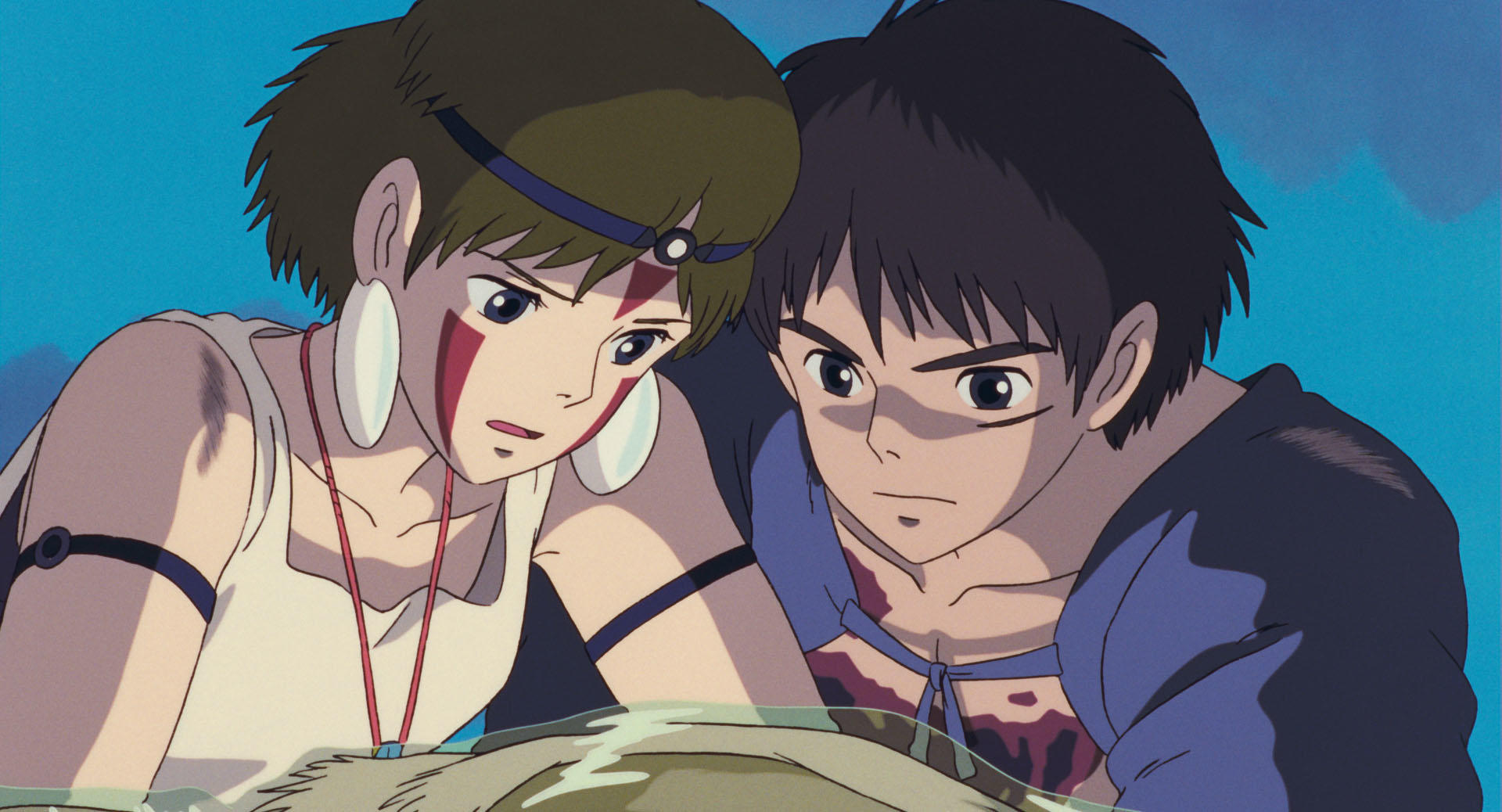
儘管阿席達卡擁有以上這些陽剛特質,他在生命垂危時仍被小桑所拯救。電影也並未特別描寫他有用帶有情慾的角度看待小桑。當小桑咀嚼肉乾並嘴對嘴餵他時,他並沒有因為如此親密的舉動而臉紅,反而因此而流淚——這是在強大的男性角色身上鮮少看到的舉動。流淚展現了他柔軟的一面,阿席達卡此處的感受或許和大家平時生病受人照顧時的感覺相似。
另一方面,女主角小桑(魔法公主)則展現出了強大的陽剛特質。她擅長打鬥,會攻擊達達拉城以捍衛大自然和山獸神。她顯然不是傳統那種可愛、有禮貌、努力不冒犯人的女性。她還把阿席達卡帶到山獸神森林,間接拯救了他。小桑並沒有等著他人來改變她的人生,而是為她所堅信的事奮鬥。她在電影裡從頭到尾都是獨立的個體。
至於黑帽大人,她大概是整部電影裡最複雜且具爭議性的角色。她是一位受人尊敬的領導者,達達拉城在她的帶領下,藉由製作鐵彈和發明槍砲而繁榮。然而為了尋求更多天然資源,她盯上了森林,殺掉野生動物,引發和魔法公主的衝突。她一開始登場時就像是電影本身想批判的對象,但在觀眾跟隨阿席達卡的視角進到她的屋子裡時,電影卻也展現了她善良的一面——親自照顧痲瘋病患者。她絕對不是傳統的女性角色,也未落入童話裡面經常出現的敘事,並未因為是個有能力又握有權力的女性而被塑造為邪惡反派。
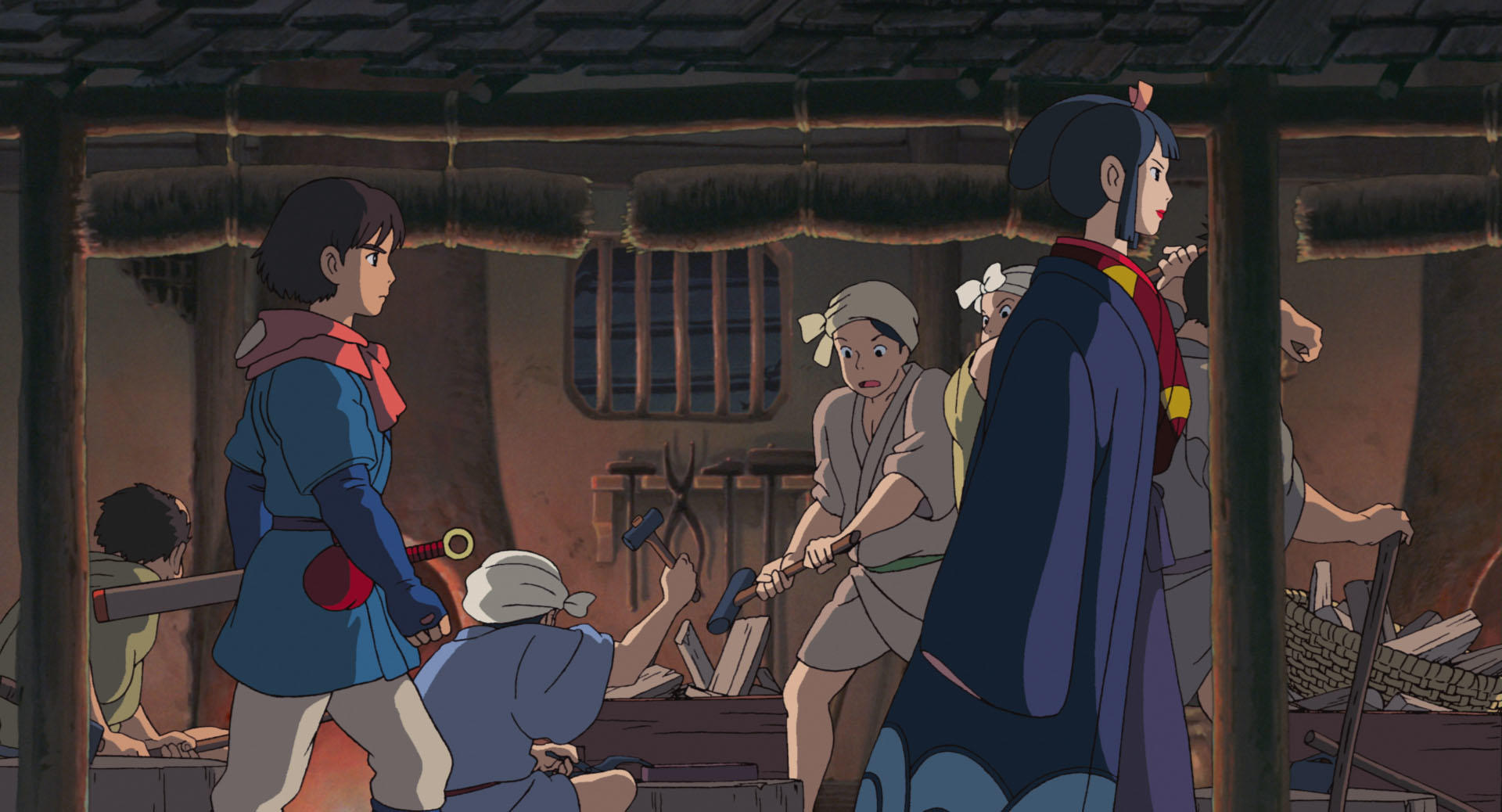
電影的時空背景設定在室町幕府晚期(十六世紀左右)的日本,但卻描繪了一座性別角色翻轉的城鎮——達達拉城。如上述所說,達達拉城擁有武力,並由黑帽大人領導。達達拉城的女性主導了城內的事務,她們在鑄鐵場工作、對敵人開槍、當眾大罵男人、大笑出聲,並以身為女性為傲。當一位男性護衛保證自己會在戰場保護黑帽大人時,女性們卻懷疑他的能力,說「要是你是女人就好了」。而達達拉城的男性雖然依舊擔任了重要的角色,卻不像城外的男性那麼自傲,尤其是面對女性的時候。
從達達拉城的男性在對阿席達卡解釋情況時的對話可得知,這裡的性別角色是因為黑帽大人的關係才如此特別。黑帽大人分派女性去鑄鐵廠踩製作鐵器的風鼓,不畏懼一般人認為「女人會弄穢鐵」的想法,甚至每次看到被賣身的女孩就會花錢贖回來。當阿席達卡問道「這裡的生活苦嗎?」,鑄鐵廠的女性回答「蠻苦的,可是比起山下那邊又好多了,可以吃得飽飽的,而且沒有臭男人囂張跋扈」。
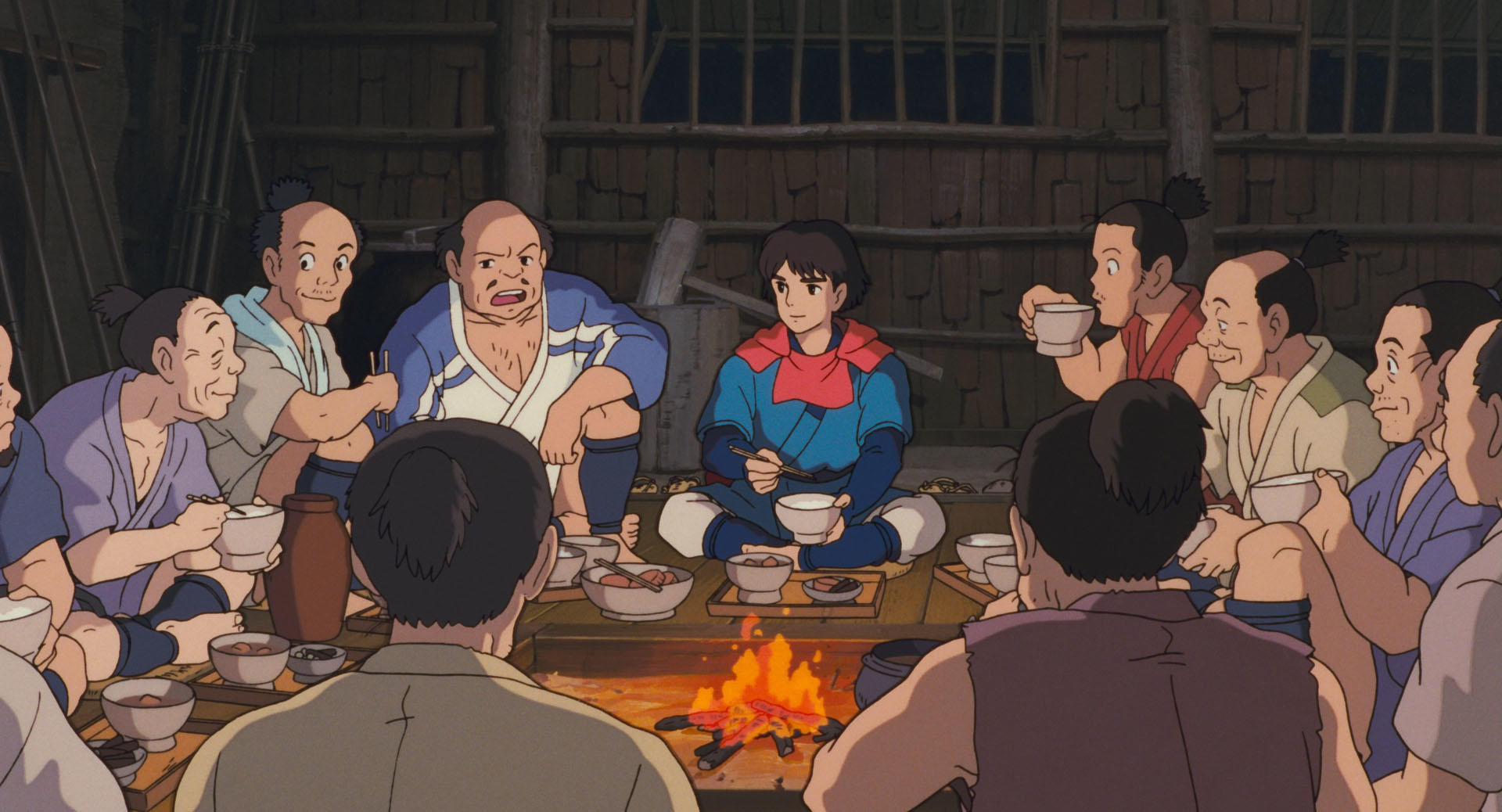
有趣的是,阿席達卡在達達拉城是被「凝視」的一方。他來到達達拉城時,阿時(她的丈夫先前被阿席達卡救起)請他拿下面罩,並讚賞他的外貌。阿席達卡和其他男性吃晚餐時,達達拉城的女性甚至聚集在門口以便「欣賞」這位帥氣的旅人,她們大笑、調侃彼此,並邀請阿席達卡到她們家過夜,要他別跟其他男性住這間臭房子。當阿席達卡拜訪工廠時,女性們都非常興奮,甚至臉紅。阿席達卡在達達拉城可說是經歷了「女性凝視(female gaze)」——也就是「男性凝視(male gaze)」的翻轉。他所受到的「凝視」就跟現實中女性時常遭受異性戀男性的凝視一樣,在凝視中被性化(sexualized),且多半會被調戲,甚至是物化,成為慾望的載體。
諷刺的是,電影裡要女人停止調戲阿席達卡的男人們,在現實中大概會是女性主義者的角色,因他們試圖阻止性別架構不平等而造成的情況。但在性別角色翻轉的達達拉城內,他們代表的就只是城外一般傳統的想法,認為女性應該要端莊矜持。
「鐵」是達達拉城的主要武力,同時也是重要象徵。達達拉城因為鐵而強大,但也因為鐵而招來其他人的嫉妒。若把這個情況和城裡男女特殊的性別角色連在一起,便能發現和現實生活相似的現象——在父權社會底下,女性必須具備所謂的陽剛特質才能捍衛自己,但與此同時卻也會因為具備陽剛的特質而受到批評。電影裡鐵製的武器正是一種陽剛的象徵,具有強大的火力,能造成損傷,亦能支配他人。現實世界裡若是一位女性想和男性競爭,除了要有傑出的能力之外,通常還需要展現一些強勢的陽剛性格,但卻又容易因此而被調侃,比如被說「跋扈(bossy)」。
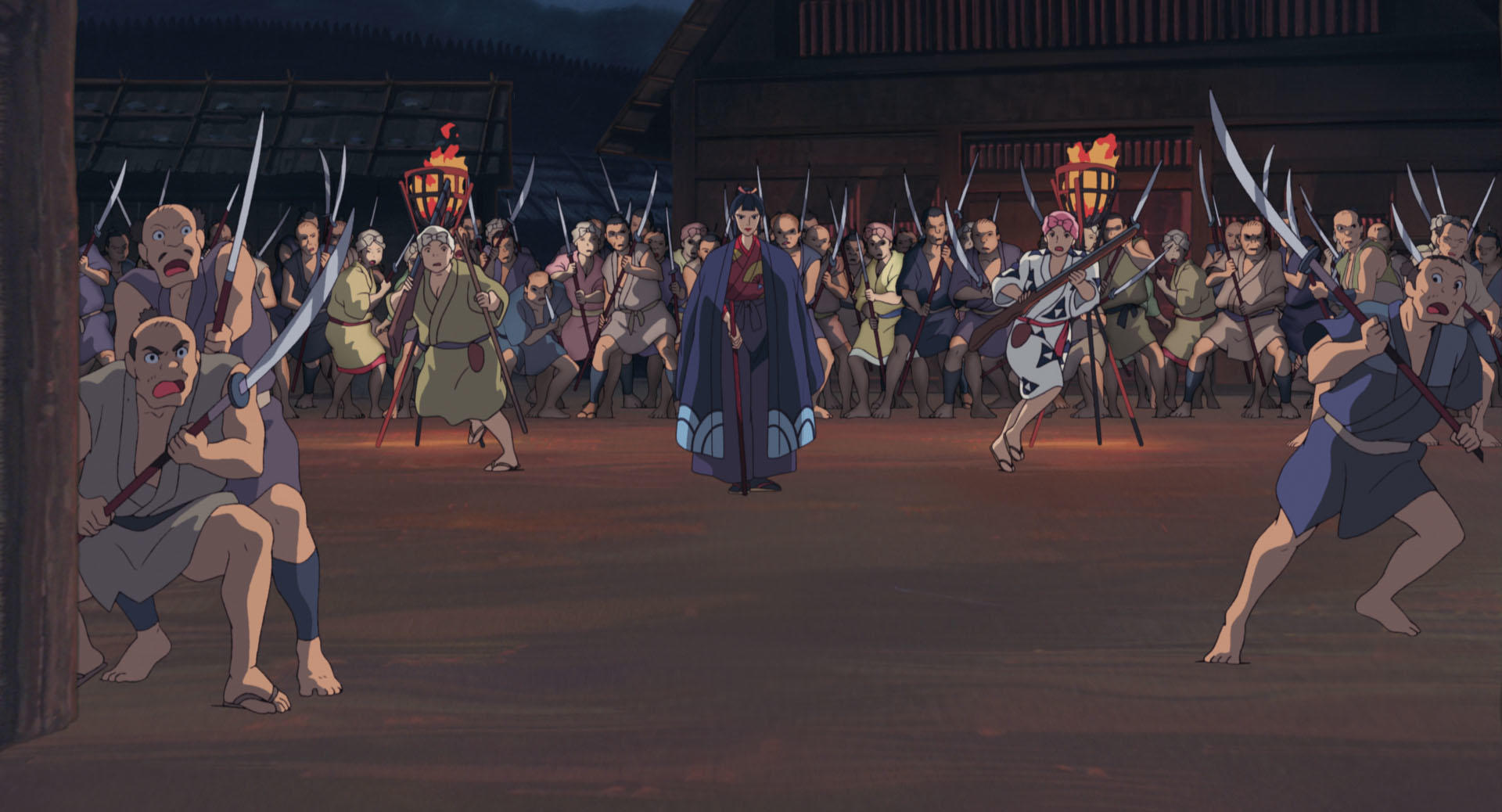
除了角色和背景設定以外,電影裡也有一些值得討論的情節。首先是小桑和黑帽大人的打鬥那幕。如同前述提到的,兩人身手極佳,武力值幾乎強過電影裡所有的男性角色。小桑突襲達達拉城想殺掉黑帽大人時,兩人以刀劍搏鬥。透過此幕可觀察到,打鬥時因講求力道、速度、技巧,傳統的陽剛特質在此仍非常重要,而女性也能夠展現這樣的特質。
再來是阿席達卡和小桑之間的互動。兩人之間並沒有公主被王子拯救的老套劇情,相反地,小桑(魔法公主)和阿席達卡(蝦夷族王子)在整部電影裡不斷拯救彼此。當阿席達卡為了阻止小桑和黑帽大人打鬥,將兩人打暈並把小桑帶離達達拉城,卻因此而被槍擊時,是小桑將他帶回森林,讓山獸神決定是否治療他,讓他活下去;當小桑在最終的戰鬥中,困在野豬神族首領乙事主因怨恨而生的邪魔身上時,是阿席達卡救了她。兩人之間的羈絆因互相拯救而變得越來越深。
最後是電影的結局,也是整部片最有意思的地方。黑帽大人雖然被狼咬掉了一隻手臂,但她活了下來,並鼓勵大家重建被摧毀的達達拉城。電影似乎並不打算改變達達拉城的社會結構,這座和外界性別角色相反的城鎮會繼續生存下去。至於阿席達卡和小桑,當小桑說自己喜歡阿席達卡,但沒辦法原諒人類時,阿席達卡說:「沒關係,小桑住森林,我住達達拉城。一起活下去吧!我會騎亞克路去找你的。」他們不像大多數童話故事的男女主角從此一起過著幸福快樂的日子,而是繼續依照自己的步調和信念生活,並約定好會和對方碰面。阿席達卡和小桑就像是並肩走在兩條道路上,兩人並未硬將對方拉到自己身邊,要對方和自己走同一條路——只是牽著對方的手,走著自己的路,一起步向未來。
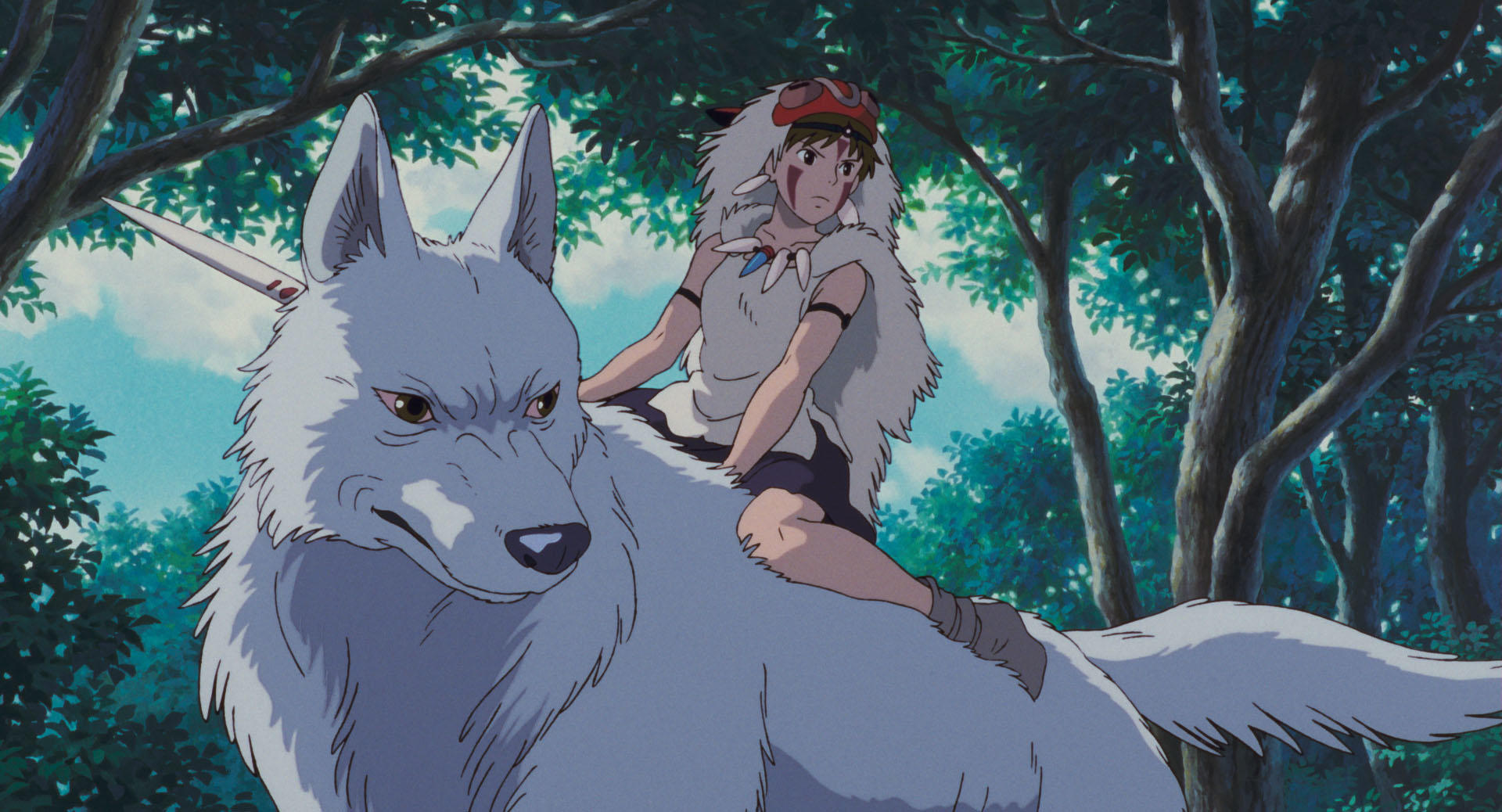
整體來說,《魔法公主》可說是部已成長茁壯的童話,在角色、故事背景、情節等面向皆翻轉了性別刻板印象。電影並未抹除男女之間的差異,而是展現了更多不同性別角色敘事的可能性。女性角色可以很強壯、會保護人、和人打架,為自己的信念奮鬥;男性角色也能夠展現自己柔軟的一面。陽剛和陰柔兩種特質就像生與死,時常同時出現,雖是徹底相反的概念,卻也代表彼此不可或缺。既然兩者並存於世,以自己的樣貌活下去才是最重要的,就像電影的最後,山獸神對阿席達卡傳達的訊息。
「祂告訴我要活下去。」阿席達卡說道。
Princess Mononoke is a 1997 Japanese animation written and directed by Hayao Miyazaki. The film is set in the late Muromachi period (14th to 16th century). Ashitaka, the male protagonist, who is the prince of the Emishi tribe, is cursed when killing a demon in order to stop it from attacking his village. Under the witch of the village’s suggestion, he sets off a journey to the west in hope to find a cure for the curse.
On his way, he learns from a monk that The Great Forest Spirit may be able to end his curse. Later, when he rescues two badly wounded men by a river, he learns that they’re from Tatara, a town led by Lady Eboshi and produces iron bullets, through which the town people fight against forest animals for more natural resource.
On his arrival to Tatara, he witnesses more conflicts among the natural forces, the Emperor, and Lady Eboshi (Tatara). Later on, Ashitaka is shot with a bullet when trying to stop the fight between Lady Eboshi and Princess Mononoke, a girl raised up by the wolves guarding the forest against human invasion. He is taken back to the forest by Princess Mononoke, whose real name is San. There, his wound is healed by The Great Forest Spirit, but the curse remains.
At the same time, the boar clan is planning for an ultimate attack toward Tatara. In the final war, Lady Eboshi and the men sent by the Emperor cut off The Great Forest Spirit’s head, which causes a destruction of life as The Great Forest Spirit looks for its head. The chaos only ends when Ashitaka and San return the head. Although The Great Forest Spirit is dead, it gives new life to the world and cures Ashitaka’s curse.
“It told me to live,”1 said Ashitaka.
Although the film seems to discuss mainly about the conflicts between human and nature, there is yet another interesting topic hidden in the film—gender stereotypes.
Gender stereotypes are common all over the world, but they seem even more significant in the majority of Japanese animations (also called “anime”). On one hand, a standard male character in an anime is strong, cool, handsome, protective, and kind. They often seem to be granted with the privilege to “admire” female characters through erotic lenses. On the other hand, the essential characteristics of female characters seem to be cute, polite, unoffending, and often sexy. Moreover, she usually needs protection from male characters. This kind of setting probably has something to do with the social value in Japan, where the boundaries between gender roles are still clear-cut comparing to the western countries, or even Taiwan. However, to my surprise, the phenomenon is not obvious in Princess Mononoke, even though it was released in 1998 and the setting of the film is in the 16th century.
When it comes to the characteristic in Princess Mononoke, Ashitaka, the main character, does not fall out of the field. He is strong, with the ability to fight, shoot arrows, and defend his villagers. He is also good-looking, which can be observed through the reactions of women in Tatara. He wants to “see things with eyes unclouded”, which makes him observant, aware of all the things happening around him. He tries to see all the aspects of things before judging them, which is surely a characteristic of kindness. Despite these masculine characteristics, he is saved by San when his life is at great danger. What’s more, the film doesn’t focus much on his perspective toward San in an erotic way. He is surprised when San chews meat and feeds him mouth to mouth, but he doesn’t even blush upon the intimacy. Instead, he cries—a behavior seldom put upon strong male characters. The tears show his soft side. It’s probably similar to the feeling that people would experience when being sick and taken care of by others.
On the other hand, San (also called Princess Mononoke), the leading female character, shows strong masculine characteristics. She is good at fighting, and she attacks Tatara, defending the nature and The Great Forest Spirit. She is obviously not the traditional cute, polite, and unoffending girl. What’s more, she indirectly saves Ashitaka’s life on the first hand by taking him to The Great Forest Spirit’s forest. San doesn’t wait for others to change her life, but stands up for the things she believes. She remains her individuality throughout the film.
As for Lady Eboshi, she may be one of the most controversial characters in the film. But above all, she is a leader who is highly respected by her people. She leads Tatara to prosperity by making iron into bullets and inventing powerful guns and canons. But in order to seek more resource, she turns to the forest and kills wildlife, which causes the conflict between her and Princess Mononoke. She seems to be criticized in the beginning, but her kind side is also shown as the audience follows Ashitaka to her house—she takes care of the lepers in person. Certainly, she is not a traditional female character. And she is not defined as a villain even though she’s a woman with great ability and power, unlike the plots that can often be seen in fairytales.
Even though the setting of the film is in the late Muromachi period (around the 16th century) of Japan, it describes a town in which gender roles are flipped—Tatara. As mentioned above, Tatara is a powerful town led by Lady Eboshi. In Tatara, women seem to be in charge of everything. They work in the iron factory, fire enemies with guns, scold men in public, laugh out loud, and are proud of being women. When a male bodyguard assures that he’d protect Lady Eboshi in the war, the women doubt his ability and say ”It’d be better if you were a woman”. Meanwhile, although men still play an important part in the town, they are not as proud as those outside the town, especially when facing women. The conversations between Tatara’s men when they explain the situation to Ashitaka show that it’s because of Lady Eboshi that the gender roles are so special here. Lady Eboshi assigns women to pump the bellows to make iron in the factory while it is generally said that women make iron dirty. She even buys girls whenever she sees one being sold. When Ashitaka asks the women if life in the factory is hard, they answer that it is, but at least it’s better than life off the mountain (Tatara is located on a mountain), where they can’t get enough food and have to face arrogant men.
What’s more interesting about Tatara is how Ashitaka is “gazed” there. First, on his arrival there, Toki, the wife of the man whom he rescues, asks Ashitaka to take off his mask and appreciate his appearance. When he is having dinner with other men, women in Tatara even gather in front of the door to “see” this good-looking traveler. The women laugh, tease each other, and ask Ashitaka to stay in their houses instead of staying in the smelly house with the men. What’s more, they are excited and even blush when Ashitaka visits their workplace. It is extremely interesting that Ashitaka experiences “female gaze”, a flip of “male gaze”, in Tatara. The way he is gazed is like the way women are gazed by heterosexual men in reality, where women are sexualized through the gaze and are often openly teased. Ironically, those who ask Tatara’s women to stop teasing Ashitaka would probably be feminists in reality. However, in the gender-flipped town in the film, they simply represent the conservative and common voice outside Tatara.
As the main force of Tatara, “iron” also served as a significant role. Because of iron, Tatara is powerful; but it is also because of iron that the town is envied by other forces. Linking this situation with the special gender roles in the town, a phenomenon that’s similar to the reality can be found: under the patriarchal society, women have to be equipped with the so-called masculinity to defend themselves, but at the same time they would also be criticized with the equipment. In the story, weapons made with iron are exactly a symbol of masculinity because of its power and the usage of hurting or being dominant. As for the real world, if a woman wants to compete with men, she often needs to show the characteristics of masculinity such as dominance in addition to her extraordinary ability. But she is also often teased by possessing this trait, such as being called “bossy”.
In addition to the characters and the setting of the film, there are also some plots worth discussing. The first is the fight between San and Lady Eboshi. As mentioned before, they are both good at fighting, with abilities surpassing nearly all male characters in the film. They fight with swords when San attacks Tatara in an attempt to kill Lady Eboshi. From this scene it can be concluded that traditional masculinity is still essential in a fight, which requires strength, speed, and skill. However, men are not the only gender that can fight in that way anymore.
The second one is the interactions between Ashitaka and San. Instead of the cliché plots of a princess being rescued by a prince, San (Princess Mononoke) and Ashitaka (the prince of the Emishi tribe) save each other throughout the story. When Ashitaka is shot because he stops San and Lady Eboshi’s fight by knocking them unconscious and tries to take San out of Tatara, it is San that takes him to the forest to see if The Great Forest Spirit would save him, giving him a chance to live. During the final war, when San is stuck in the evil spirit that grows out of hatred from Okkoto, the leader of the boar clan, it is Ashitaka who saves her this time. Through saving and being saved, the connection between the two grows deeper and deeper.
Last but not least, the ending is probably the most significant part in the film. Although being bitten off an arm by the wolf, Lady Eboshi survives. She then encourages everyone to rebuild Tatara, which is destroyed in the final war. It can thus be deducted that the gender-flipped town will live on, and that the film doesn’t aim to change the social status in Tatara. As for Ashitaka and San, when San says that she likes Ashitaka but can’t forgive human beings, Ashitaka replies, “That’s alright. You’ll live in the forest, and I’ll live in Tatara. We live, together. I’ll ride Yakul (a fictional elk) to see you in the forest”. Instead of being happily ever after together like most of the fairytales, they promise to see each other, but stay with their own life patterns and beliefs. The relationship between Ashitaka and San is like walking on two straight roads abreast. One doesn’t grab the other to walk on the same road with them. Instead, each walks on their own road while holding the other’s hand, together toward the future.
In conclusion, Princess Mononoke is a grown-up fairytale that flips the stereotypes of genders in its characters, setting, and plots. Although Princess Mononoke doesn’t wipe out all the social differences between men and women, it indeed brings another possibility of portraying gender roles in stories. Female characters can be strong, protective, and fight physically for their beliefs, and male characters can show their soft sides. Masculinity and femininity are like life and death, constantly appearing together. They are contrast ideas: without one, the other wouldn’t exist. And since they both exist in life, all we should do is live as ourselves, just like the message the film conveys in the end.
- Translated from the original Japanese dubbing, since the English version differs a little ↩︎
 鯊丁魚
鯊丁魚 